
Individuals suffer from a critical teamwork skill gap in the workforce.
 Despite the pressing need for highly effective and productive teams, many individuals are either unaware or unable to consistently practice the behaviors that will ensure team success. This is primarily because employees see teamwork as something that comes naturally to them and as learned only through personal experiences on teams. In other words, they don’t view teamwork as something they need to learn, especially when 99% of respondents consider themselves “good” and “effective” team members.
Yet this optimism is belied by our historical The Five Behaviors® assessment data—compiled over 2019 from more than 13,000 participants in The Five Behaviors program—which paint a much bleaker picture. Looking at team performance through the lens of Patrick Lencioni’s The Five Dysfunctions of a Team, we see considerable room for improvement across several crucial behaviors.
The Reality of Teamwork
 no trust
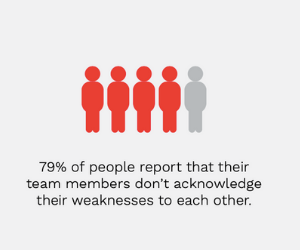
No trust with team members: Nearly 4 in 5 people report that their team members are typically not willing to acknowledge their weaknesses to one another, which highlights the pervasive lack of vulnerability-based trust throughout the workplace.
no commitment
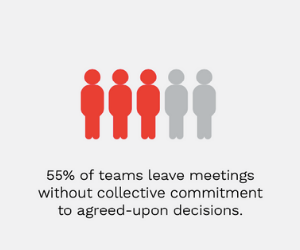
No commitment to decisions: More than half of teams usually leave meetings without everyone committing to agreed-upon decisions. That means employees will likely struggle to find meaning or motivation in their work, and the team’s results will suffer.
 no accountability
No accountability for poor results: When a team fails to achieve its collective goals, roughly 3 in 5 people report that their team members often refuse to take personal responsibility to improve their team’s performance in the future. An unwillingness to examine errors and the opportunity for improvement—or, worse, blaming coworkers for problems—is a recipe for mediocre team performance.
1 DiazGranados, Deborah, Marissa L. Shuffler, Jesse A. Wingate, and Eduardo Salas. 2017. “Team Development Interventions” in The Wiley Blackwell Handbook of the Psychology of Team Working and Collaborative Processes. Hoboken, NJ: John Wiley & Sons, Inc.
2 Respondents were asked a range of questions aimed at understanding their involvement on teams and engagements with team members. This included questions about the characteristics of teams they’re on, ineffective teamwork and its consequences, and the frequency and importance of various team behaviors.
3 Based primarily in the United States.